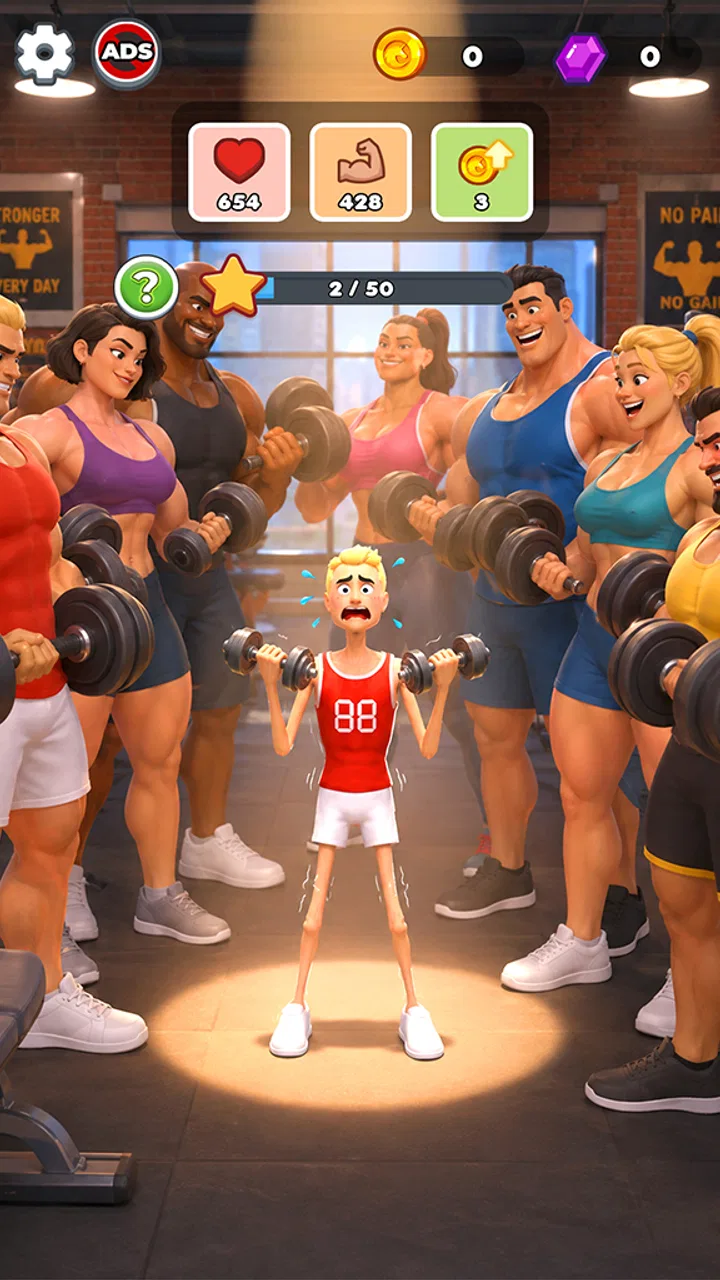
Gym Idle Clicker: Fitness Hero
- 4.7
- Rating
- 50.00M
- Installs
- Free
- Price

 Analysis by App-foxy
I went into Gym Idle Clicker: Fitness Hero expecting a lightweight tapping game, and that is exactly where its appeal begins. It turns the idea of training into a simple loop: tap, improve your virtual muscles, and keep pushing toward a stronger gym character. The concept is easy to understand within seconds, but it has enough gradual progress to make short sessions feel worthwhile.
What surprised me was how well the game fits the small gaps in an ordinary day. I could open it while waiting for a kettle to boil, make a few upgrades, and close it without feeling that I had started a demanding commitment. That convenience is the main reason it works as a casual game. It is not trying to replace a workout plan, teach real exercise technique, or simulate a complete fitness routine. It is a playful progress tracker built around the fantasy of becoming stronger.
The important question, though, is whether that first burst of satisfaction survives after the novelty fades. My answer is qualified: the game is enjoyable when I treat it as a brief routine rather than a game that deserves constant attention. Its strongest quality is the low effort needed to return to it. Its weakest quality is that the same simplicity can eventually make each session feel familiar.
You May Also Like

 Blood Strike: 2.5 Anniversary
Blood Strike’s Loadouts Turn Every Drop Into a Tactical Gamble
A close look at Blood Strike’s custom loadouts: how fast access to signature weapons reshapes its battle royale rhythm, rewards preparation, and narrows the gap between fights.

 Pandora - Music & Podcasts
Pandora’s Music Is Easy to Start, but Harder to Recover
Pandora’s strength is its low-effort path from a seed to a station. Its weak spot is how much confidence it asks you to place in connection, setup, and quiet recovery.

 8 Ball Pool
 Is Built on Rivalries, Rematches, and Routine
A close look at the rivalries, rematches, shared routines, and unanswered safety questions that turn a quick pool match into a persistent mobile community.

 Samsung Music
’s Quiet Strength Is Playing What You Already Own
Its reach comes less from spectacle than from dependable access to a personal library. That simplicity is both the app’s strongest retention engine and its ceiling.

 AccuWeather: Weather Radar
AccuWeather Review: A Quick, Clear Forecast for Everyday Decisions
For everyday plans, the best forecast is the one you can understand quickly. AccuWeather makes rain timing, radar, and local conditions easy to act on, with a few trade-offs.

 Hill Climb Racing
Why Hill Climb Racing Still Turns Crashes Into One More Run
A tiny car, a bumpy hill and one more upgrade: Hill Climb Racing keeps resurfacing because its simple chaos makes every near-miss feel personal.
More From Our News Desk



Why the first week feels so satisfying
The opening experience is deliberately approachable. There is no need to learn a complicated control scheme or understand a large set of rules before making progress. Tapping is the central action, so the feedback is immediate. Each interaction feels connected to the character’s improvement, which gives even a short visit a clear purpose.
I found the game especially comfortable for players who enjoy incremental progress but do not want the pressure of a competitive multiplayer environment. The casual format means I can play at my own speed. There is no need to schedule a long session, remember a complex build, or study a strategy guide before deciding what to do next.
During the first few days, the strongest motivation comes from seeing small improvements accumulate. The game turns repetition into a visible sense of development. That is a familiar idea in idle and clicker games, but the gym theme gives it a more focused identity than a completely abstract number-increase game. I am not simply collecting points; I am imagining a virtual athlete becoming more capable.
A useful way to play is to divide visits into two kinds. In a quick session, I tap enough to make one meaningful improvement and then leave. In a longer session, I stay to explore how far the current progress can carry me. This distinction matters because trying to force every session to be long makes the basic loop feel more repetitive than it needs to be.
The game is also a good fit for people who like motivational framing without wanting a serious fitness application. The language of muscles, training, and becoming stronger creates a small sense of purpose, but the experience remains entertainment. I would not use it to count real exercise, plan resistance training, or judge physical performance. Its value is emotional and recreational: it makes progress feel satisfying without demanding physical effort.
One practical tip is to avoid treating every tap as something that must be optimized perfectly. The pleasure comes from the rhythm of improvement, not from turning the game into a spreadsheet. If I focus too heavily on extracting maximum efficiency from every moment, the relaxed character of the game disappears. The best early experience comes from making sensible improvements and enjoying the visual idea of a growing virtual gym hero.
Its broad reach is understandable. The game is free, carries an Everyone 10+ content rating, and has passed the fifty-million-install mark. Those details do not guarantee that every player will enjoy it, but they show why it has become easy to encounter among casual mobile games. The average rating is 4.8 from around 116 thousand ratings, which also suggests that the straightforward loop connects with a large audience.
Who gets the most from the opening
I would recommend the first week to people who enjoy idle clickers, simple progression, or games that can be checked several times without demanding full concentration. It is also suitable for someone who wants a cheerful distraction during commuting, breaks, or quiet evenings. The virtual fitness theme gives the tapping a recognizable context, so it feels more purposeful than pressing a button with no story around it.
It is less suitable for players who need deep tactics from the beginning. If you want a game with elaborate character builds, complex battles, or a large world to explore, this will probably feel too narrow. The same simplicity that makes it welcoming can make it seem shallow to anyone looking for a substantial role-playing system.
Another early trade-off is the difference between visible progress and meaningful variety. At first, almost any improvement feels meaningful because the player is still learning the rhythm. Later, the question becomes whether the actions themselves remain interesting. That is the first sign of the game’s long-term challenge: progress can continue even when discovery slows down.
What remains after the novelty wears off
After the first month, I think the game’s value depends less on excitement and more on habit. The basic action does not suddenly become complex, so continued enjoyment comes from returning to a familiar routine. For some players, that is exactly the point. A small daily check-in can be relaxing, especially when the goal is simply to make gradual progress rather than complete a demanding challenge.
I found it helpful to attach the game to an existing pause in my day. Opening it after lunch or during an evening wind-down made it feel like a tiny ritual. The session did not have to be long. What mattered was that the game offered a clear, low-friction activity at a predictable moment. This is a more sustainable approach than opening it repeatedly whenever the progress bar feels urgent.
The gym theme supports this habit because it naturally suggests consistency. Even though the activity is virtual, the idea of training regularly gives each return a little context. The game is at its best when I use that theme as a gentle reminder to maintain progress, not when I expect it to deliver the depth of a real training program.
There is also a useful psychological trade-off in its design. Immediate tapping gives me control, while longer-term improvement gives me a reason to come back. If I only tap without caring about the broader progression, the game can feel mechanical. If I only wait for progress without interacting, it can feel passive. The most enjoyable balance is to use short active bursts to refresh interest, then leave the game before the repetition becomes tiring.
Compared with a traditional arcade game, this offers less moment-to-moment challenge but more continuity between sessions. Compared with a real fitness app, it offers far less practical guidance but also far less pressure. Compared with a deeper role-playing game, it has a smaller range of decisions and a much gentler learning curve. Its place is between those alternatives: a casual progress toy with a fitness-flavored theme.
That comparison also clarifies who should choose something else. If your goal is accountability for real exercise, a workout tracker or coaching app is the better tool. If you want intense reflex challenges, an action game will provide more variety. If you like idle games specifically because of their calm, repeating progression, this one has a reasonable chance of staying installed.
How I would keep the routine fresh
My most effective approach was to set a personal stopping point for each visit. I would decide in advance that I was making one upgrade, checking the current progress, or spending a short break with the game. This prevented the session from turning into endless tapping. It also made the next visit feel like a continuation rather than an obligation.
I would also avoid comparing the game with real gym achievements. That comparison creates the wrong expectation. The app’s virtual muscle-building idea is playful, and its feedback is designed to make digital progress satisfying. It should be judged by whether it provides a pleasant casual loop, not by whether it can replace movement, coaching, or a structured exercise plan.
Players should be aware that the game includes in-app purchases priced at $2.99 per item. The free entry is a genuine advantage for trying the experience, but spending can change how comfortable the progression feels for each person. I prefer to decide early whether I am happy with the free loop. If the game already feels repetitive without paying, a purchase is unlikely to solve the underlying issue of limited variety.
The current version is 1.0.59, and the game supports Android 7.0 or later. That makes it accessible on a wide range of Android devices, including older phones that may not be suited to more demanding games. For a casual title built around tapping and steady progression, broad device compatibility is a practical strength because it lowers the barrier to making the game part of a regular routine.
The maintenance burden is pleasantly small
One of the best long-term qualities is the low maintenance burden. I do not need to remember a complicated sequence of actions before I can enjoy a session. There is no intimidating preparation stage, and the central interaction is always easy to find. That matters more than it sounds: many mobile games lose me because returning after a few days feels like homework.
Here, returning is simple enough that a missed day does not feel like a disaster. I can pick up the virtual training idea again without reconstructing a large story or learning a new set of controls. This makes it a good companion for inconsistent schedules. Someone who has only a few minutes on some days can still understand what the game is asking them to do.
The low commitment also makes it appropriate for shared devices or casual family use, with the age rating in mind. I would still pay attention to purchasing habits, particularly if younger players have access to the device, because the presence of per-item purchases changes how the free experience should be managed. The game itself is easy to approach, but responsible settings and supervision remain sensible around any app with optional spending.
There is a difference between low maintenance and unlimited longevity, however. A game can be easy to revisit without being endlessly engaging. In this case, the maintenance advantage is strongest for people who enjoy returning to a familiar loop. Players who need constant new goals may find that convenience turns into sameness.
The developer, Unicorn Studio Official, has positioned the experience around a very clear fantasy rather than a complicated collection of systems. That focus helps the game remain readable. I always understand why I am tapping and what the virtual training theme is trying to convey. The cost of that clarity is that there are fewer layers to rediscover after the first sessions.
Where fatigue starts to appear
The main source of fatigue is repetition. Tapping is satisfying when each action feels like part of a fresh climb, but the sensation can flatten when the player has already understood the entire basic idea. This is not a flaw unique to this title; it is the central risk of the clicker format. The question is whether the surrounding theme and progression are enough to make repetition comfortable.
For me, fatigue appeared when I played beyond the natural length of a short break. The game works better in small portions than in a long uninterrupted sitting. That is an important practical limitation. Someone looking for a game to occupy an entire evening may run out of interesting interaction sooner than expected.
Another possible frustration is the mismatch between the word “fitness” and what the app actually provides. The theme is about virtual muscle growth, not real-world instruction. A player who downloads it expecting exercise demonstrations, personalized routines, or health tracking will likely be disappointed. I see it as a fitness-themed casual game, and that distinction should be clear before installing it.
There is also a motivational ceiling. Digital strength can feel rewarding, but it does not create the physical or social accountability that helps many people maintain real habits. If your aim is to stand up, move more, or follow a progressive training plan, this should be an entertainment supplement at most. It can make the idea of consistency feel pleasant, but it cannot perform the work for you.
In-app purchases may add another layer of hesitation for players who prefer completely uncomplicated free games. At $2.99 per item, each purchase is not presented as a large commitment, but repeated small purchases can still alter the overall experience. My advice is to treat the free version as the test. Only consider spending if the core loop already gives you lasting enjoyment and you understand exactly what you want from the purchase.
The game is also not the right choice for someone who dislikes idle mechanics on principle. If watching numbers or progress grow is not rewarding to you, the gym presentation will not completely change that reaction. Likewise, players who want a strong narrative, exploration, or competitive mastery should look elsewhere. This is deliberately modest, and its modesty is both its identity and its limit.
Does it earn a lasting place?
My long-term verdict is that Gym Idle Clicker: Fitness Hero earns a place for the right kind of player, but not as a permanent main game for everyone. I would keep it installed if I wanted a calm, low-effort title for brief breaks and gradual progress. I would not choose it as my only mobile game, because its central interaction can become predictable once the first-week excitement has passed.
The strongest case for keeping it is consistency. It is free to start, easy to understand, compatible with Android 7.0 and later, and built around sessions that do not require much preparation. The game’s 50M+ installs and 4.8 average from roughly 116K ratings reflect broad appeal, while its 367 reviews and 1.0.59 version identify the current store presentation. I would treat those figures as context rather than a promise that the experience will match every player’s taste.
For an everyday scenario, imagine finishing a short break at work and wanting something more engaging than scrolling but less demanding than a competitive match. A few minutes of virtual training can fit that moment well. You can make progress, enjoy the gym theme, and put the phone away without needing to remember a complicated objective. That is a genuine use case, not just a marketing idea.
My more advanced recommendation is to protect the game from overexposure. Do not turn every idle moment into a session. Keep it for specific pauses, and let the sense of progress build between visits. This preserves the small reward that makes the title pleasant. If you play continuously to force faster growth, you may reach the repetitive parts before the game has had time to become a comfortable habit.
I would recommend it to casual players who enjoy tapping, incremental improvement, and a playful virtual workout theme. I would also recommend it to someone who wants a simple game that can survive an irregular schedule without becoming difficult to resume. I would skip it if I wanted real fitness guidance, rich strategy, long narrative campaigns, or demanding action.
In the end, the app does not need to be deeper than it is to be enjoyable. Its lasting value comes from being easy to open, easy to understand, and easy to leave. That is a smaller promise than a full fitness platform or a major role-playing game, but it is a realistic one. If you treat it as a short daily progress ritual rather than a complete workout or an endless challenge, it has a fair chance of staying useful after the novelty fades.
FAQs for Gym Idle Clicker: Fitness Hero
01What is the main objective of Gym Idle Clicker: Fitness Hero?
Gym Idle Clicker: Fitness Hero is a casual simulation game where players aim to build and manage their own gym empire. The objective is to attract clients, upgrade gym equipment, and expand facilities. As players progress, they earn more in-game currency, allowing them to unlock new features and enhance their gym's reputation.
02Are there any in-app purchases in Gym Idle Clicker: Fitness Hero?
Yes, Gym Idle Clicker: Fitness Hero offers in-app purchases. These can include various items like currency packs, special equipment, or boosters that can speed up progress. While the game can be played without spending money, some users may opt for purchases to enhance their gameplay experience or progress faster.
03Is an internet connection required to play Gym Idle Clicker: Fitness Hero?
Gym Idle Clicker: Fitness Hero can be played offline, allowing users to enjoy the game without a constant internet connection. However, certain features like updates, leaderboards, or special events might require an internet connection to access. Playing online can enhance the game’s social and competitive aspects.
04How does the progression system work in Gym Idle Clicker: Fitness Hero?
Progression in Gym Idle Clicker: Fitness Hero involves upgrading equipment, attracting more clients, and expanding gym facilities. Players earn in-game currency by tapping or automating processes, which they can reinvest into their gym. As the gym grows, players unlock new features, equipment, and challenges that increase the complexity and excitement.
05What makes Gym Idle Clicker: Fitness Hero different from other idle games?
Gym Idle Clicker: Fitness Hero stands out with its fitness-themed setting, offering a unique twist on the idle game genre. The game combines management simulation with idle mechanics, providing a sense of progression and achievement. Its vibrant graphics and engaging sound design enhance the experience, making it appealing to fans of both fitness and gaming.
Pros
- Engaging idle gameplay mechanics.
- Colorful and appealing graphics.
- Wide range of gym equipment to unlock.
- Progression feels rewarding and fun.
- Free to play with optional purchases.
Cons
- Repetitive tasks can become tedious.
- In-app purchases can be pricey.
- Requires internet connection to play.
- Advertisements can be intrusive.
- Limited customization options for avatars.

Gym Idle Clicker: Fitness Hero
Gallery